
Hip Joint
Hip Joint Injuries & Treatment
Hip Joint Treatment
Anatomy
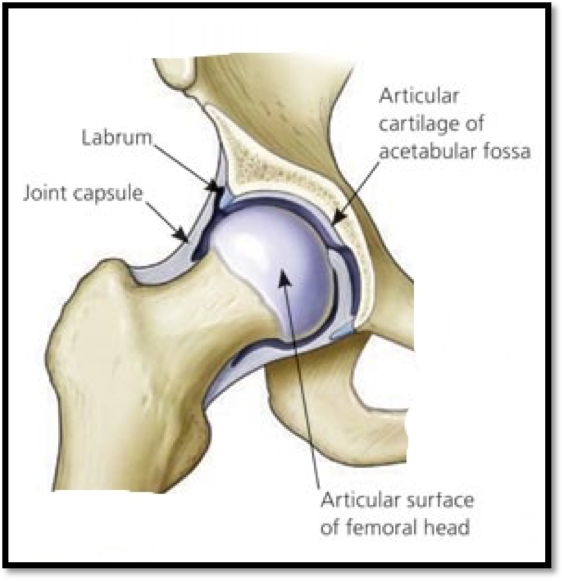
The hip joint is the largest joint of the body and very large and thick muscles surround it. It is perfect ball and socket joint with the thighbone (femur) having a globular upper end fitting into the socket of the hipbone (Pelvis). Very thick ligaments then envelop this joint, which is then covered with muscles. Hip joint problems, which can be treated with arthroscopy, include synovitis of the hip, various loose bodies, labrum tears and abnormalities of the shape of femur head (Femoro-acetabular impingement). If you are facing any hip related problems or having injury you must visit our hospital in Surat. Our Dr. Nandan Rao has great experience to treat hip injuries & do hip replacement surgeries
Types of Hip Injuries & Treatments
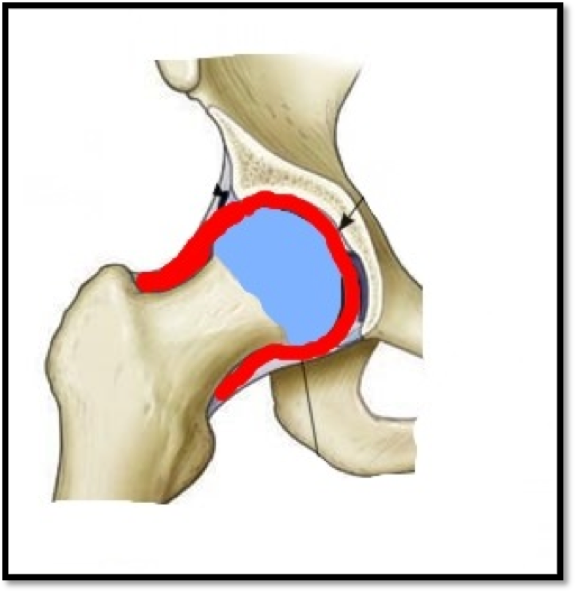
HIP JOINT SYNOVITIS
1. What is hip joint synovitis?
• Cannot be diagnosed by blood tests and radiological tests like MRI.
• Cannot be treated completely by medicines.
2. How do I know if I have synovitis?
Patients have pain in the hip, which increases with all movements of the hip, difficulty in walking with or without fever. If there is infection the symptoms start and progress very rapidly within 1-2 days with very high-grade fever and patient is very unwell. Often patients with more chronic problems have undergone multiple MRI and other investigations without pain relief.
3. How can arthroscopy help in these cases?
In these cases a hip arthroscopy is useful to obtain tissue directly from the hip for diagnosis. Although this is not the treatment it does help to get a diagnosis. Hip arthroscopy is also useful to remove the inflamed tissue or the infected tissue as a part of the whole treatment process.
4. What is the duration of hospital stay? Do I require any bed rest?
The stay in hospital is about 1-2 days. Rest is required till pain relief and then patient can start walking and attending office depending on the hip problem and the diagnosis.
HIP JOINT SYNOVIAL OSTEOCHONDROMATOSIS AND HIP JOINT LOOSE BODIES
1. What is Hip Joint Synovial Osteochondromatosis?
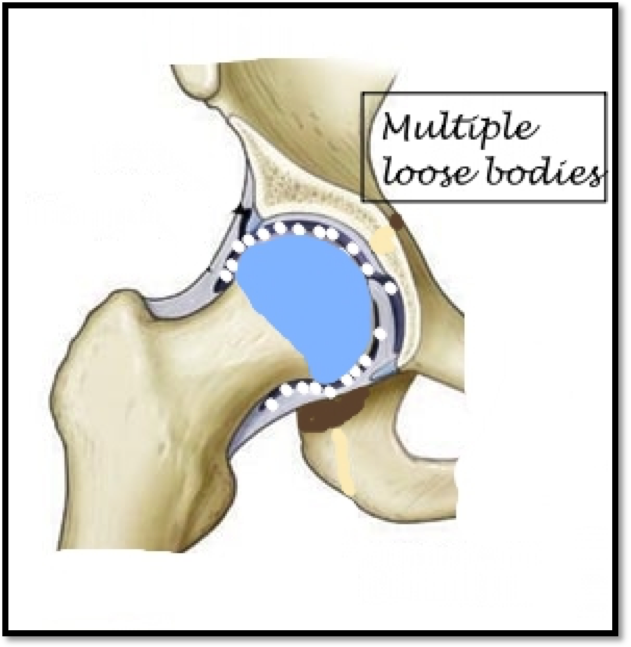
This condition is seen in young patients between the ages of 20-45 years. The inner lining of the hip joint starts to abnormally produce excess cartilage and bone like tissue. Normally this lining produces a lubricating fluid. These cartilage-like loose bodies within the hip joint initially irritate and then abrade the cartilage of the joint. Cartilage is the protective covering over the joint surface. Loss of this protective covering leads to arthritis and damage of the hip joint.
2. What are the symptoms?
Patients have pain in the hip, difficulty in walking, stairs, sitting cross-legged, squatting and other activities of daily living. In early cases patients are apparently normal but cannot walk long distances and complain of a particular heaviness of the hip joint.
3. What is the treatment?
Hip arthroscopy i.e surgery through small puncture wounds around the hip is needed. All the loose bodies and the joint lining is removed. This surgery avoids the traditional method where a big incision was taken, splitting the muscles and doing the surgery.
4. What is the hospital stay and the recovery period?
The stay in hospital is 2-3 days and patients can start walking with walker as soon as pain is tolerable. Usually patients are able to get back to office within 2-3 weeks.
5. Is there a chance of recurrence?
Yes, rarely this condition may recur but there it can be treated.
6. Why does this condition occur?
The cause of this condition is not known. Many researchers have tried to find a cause but could not.
7. What are loose bodies?
These are free pieces of bone or cartilage, which lie within the hip joint. They are like pebbles in a flowing river. They move within the joint with joint movement. A foreign body in the eye irritates the eye and the eye turns red and painful. Similarly a loose body in a joint irritates and over a long period of time causes destruction and arthritis of the joint.
8. How does a loose body come in the hip joint?
Usually a loose body enters the hip joint after a significant hip joint injury like road accident or fall from height, which causes a fracture of either bone of the hip joint. The other cause is synovial osteochondromatosis.
9. What are the symptoms and treatment for loose bodies?
The symptoms, treatment and recovery are similar to what has been given for synovial osteochondromatosis.
FEMORO-ACETABULAR IMPINGEMENT
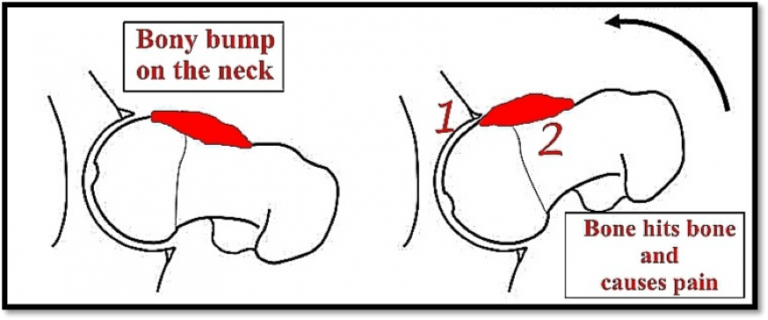
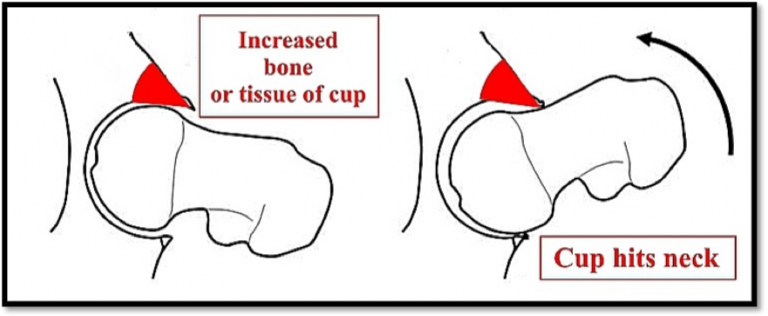
1. What is Femoro-acetabular impingement?In normal Hips when we squat or sit cross-legged the Cup of the hip joint allows the head and neck of the upper part of the thigh bone to move freely. This is shown in this diagram where the edge of the cup (1) does not hit the neck of thigh-bone (2) when the patient sits cross-legged.
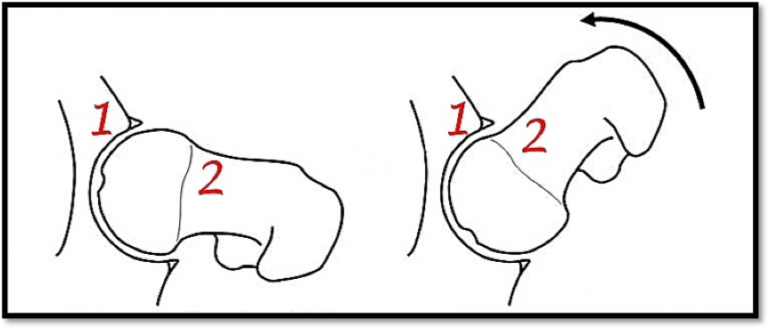
However in some patients either is extra bone growth in neck or there is extra bone or tissue growth in the cup which does not allow movements of the hip freely or causes pain. This is called Femoro-acetabular impingement.
2. What are the symptoms?
This is usually seen in young to middle aged patients (20-45 Years of age). Patients usually complain of pain while sitting cross-legged or squatting (sitting in Indian Toilet) or climbing stairs. Sportspersons complain pain in the hip during sports activities. Usually there is no pain at rest.
3. What is the treatment?
Usually the first line of treatment is non-operative. If patients are relieved then arthroscopic surgery is required usually to remove the excess bone and reshape the neck and head of bone to allow free movement.
4. What is the hospital stay and the recovery period?
The stay in hospital is 2-3 days and patients can start walking with walker as soon as pain is tolerable. Usually patients are able to get back to office after 3 weeks.
5. What if I don’t get this condition operated?
If there are persistent symptoms and patients do not get operated they continue to have the problems in daily life. Sportspersons are able to play in short term but frequent hip pain forces frequent break in the career. In the long term this condition leads to osteoarthritis of the hip which again increases the pain and disability.
Type your paragraph here